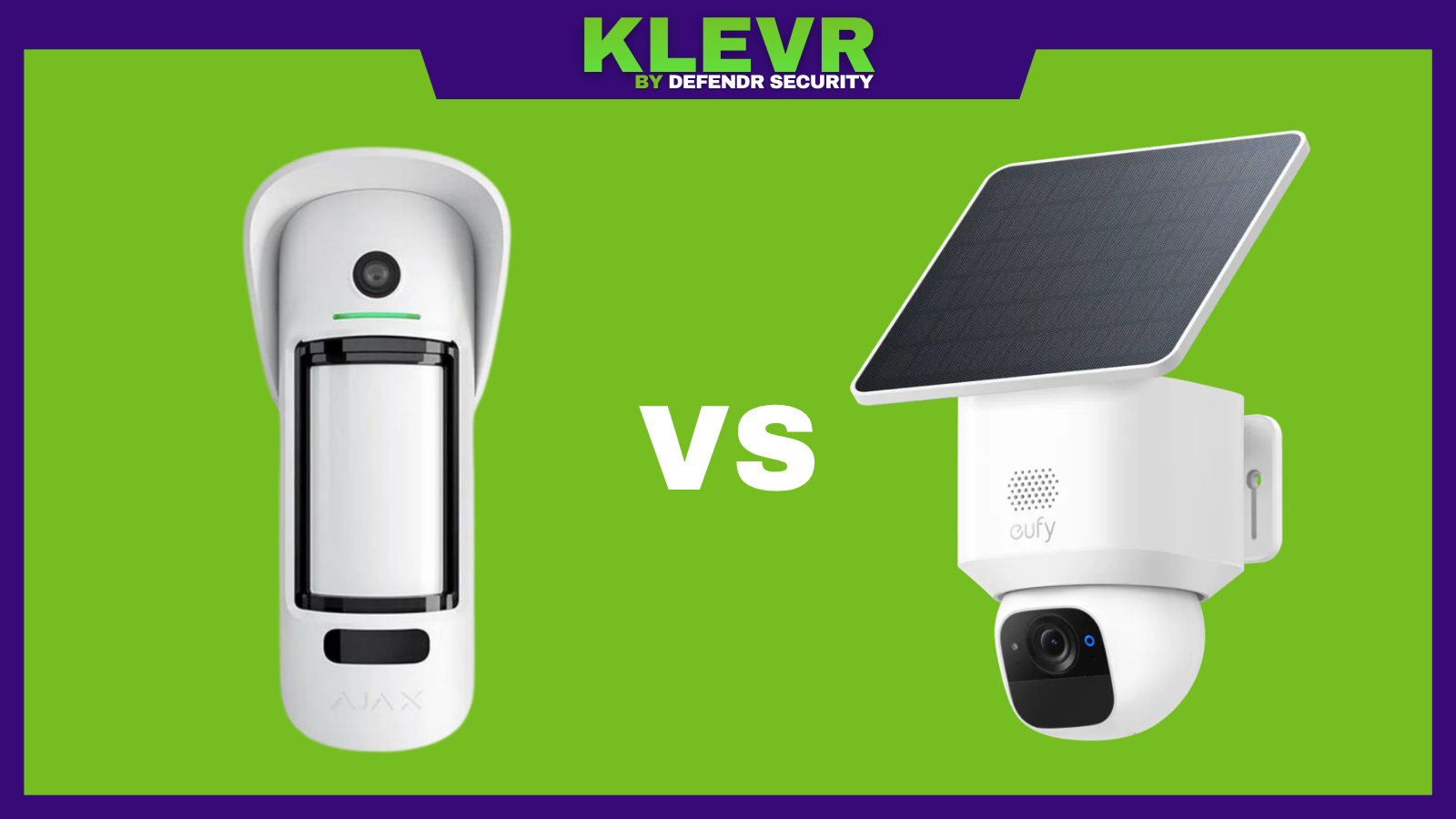
The Outdoor MotionCam is built for security first
A live-view camera helps you watch. MotionCam helps verify what triggered an armed security event. Understanding that difference makes it easier to build the right camera strategy.
Your security camera should not become another privacy problem
Outdoor cameras protect some of the most private parts of your life.
They can see who approaches your home, when your family comes and goes, what happens in your backyard, and sometimes even through windows into your living space.
That makes one question just as important as image quality:
Where is that information going?
Many consumer wire-free cameras are designed as internet-connected video devices. They connect to your home network, communicate with an app or cloud services, and may rely on remote infrastructure for features such as notifications, storage, AI processing, or remote viewing.
AJAX Outdoor MotionCam takes a fundamentally different approach.
It is an intrusion detector first—and a visual verification device second.
Outdoor MotionCam does not need your Wi-Fi for visual verification
This is one of the biggest differences.
AJAX Outdoor MotionCam does not need to join your home's Wi-Fi network to perform its core alarm and visual-verification functions.
Instead, it communicates directly with the AJAX security hub.
When the system is armed and the PIR detector identifies motion, the alarm event is transmitted through AJAX's Jeweller radio technology. Verification images are transmitted through AJAX's dedicated Wings radio technology.
That means the detector itself does not need your Wi-Fi password and does not need to behave like another conventional Wi-Fi camera sitting on your home network.
Detect. Alarm. Verify.
That is its job.
Security starts with the architecture
KLEVR believes privacy should not simply be another checkbox buried inside an app.
It should influence how the security system is designed.
AJAX's Jeweller communication technology uses two-way radio communication and AES-based encryption and includes protections against jamming, tampering, signal forgery, and communication failure.
Outdoor MotionCam is therefore part of the alarm system's dedicated communications architecture rather than simply being another Wi-Fi-connected camera.
That distinction matters.
Every internet-connected device you add to your home creates another piece of technology that has to be configured, maintained, updated, and trusted.
Outdoor MotionCam reduces that dependence at the detector itself.
Compare that with a typical wire-free camera
A conventional battery or wire-free surveillance camera is designed around video.
It may connect to your Wi-Fi, communicate with manufacturer servers, provide live viewing through an app, upload or synchronize information, process smart detections, and store video locally or remotely depending on the product.
That can be extremely useful.
But it also means you should understand exactly what you are buying.
Before installing any internet-connected camera around your home, ask:
- Who actually manufactured the hardware?
- Does the camera require an internet connection?
- Does it connect directly to my Wi-Fi?
- Where are recordings stored?
- Does any video or metadata leave my home?
- Which features require cloud processing?
- Is communication encrypted?
- Has the manufacturer had previous security or privacy incidents?
- How long will the manufacturer provide security updates?
- Can the system continue protecting me if my internet connection goes down?
A low purchase price should not be the only consideration when the product may be watching your home for years.
The logo on the box may not tell the whole story
A significant part of the global consumer and professional surveillance-device supply chain involves manufacturers based in China.
That does not automatically make a camera insecure.
The more important issue is transparency.
The security industry has documented cases where cameras sold under American or other brand names were actually OEM or relabeled products manufactured by companies such as Hikvision, Dahua, Sunell, and others.
Sometimes the customer may have little idea who actually designed the hardware, firmware, or underlying platform.
For an ordinary household gadget, that might be a minor concern.
A security camera is different.
It is an IoT computer with a lens pointed at your property.
You deserve to know who built it, how it communicates, where its data goes, and who is responsible for keeping it secure.
Eufy is an example of why those questions matter
Eufy is a popular consumer security-camera brand owned by Anker.
Its cameras have offered attractive features such as battery operation, local storage, smart detection, and easy installation.
But Eufy has also faced documented criticism over security and privacy practices in the past.
The important lesson is not that every Eufy camera is insecure today.
In fact, Eufy has subsequently emphasized stronger encryption, local storage, and local AI processing in newer products.
The lesson is that privacy architecture matters—and manufacturers can change it over time.
Consumers should understand what information a camera sends outside their home instead of assuming that "local storage" or "wire-free" automatically means private.
Outdoor MotionCam collects a different kind of visual information
There is another important distinction.
Outdoor MotionCam is not designed to continuously watch your property like a traditional surveillance camera.
Its camera exists primarily to provide visual information associated with security events.
When an armed detector triggers, MotionCam can provide images that help answer the question:
What caused the alarm?
Was it a person?
Was something moving near the protected area?
Is there evidence that someone is actually on the property?
That information can make an alarm significantly more useful without requiring another conventional always-on Wi-Fi surveillance camera for that particular detection point.
Privacy by purpose
There is a simple principle behind the way KLEVR thinks about security technology:
A device should collect the information it actually needs to do its job.
A motion detector does not necessarily need to become an always-on streaming camera.
Outdoor MotionCam detects intrusion and provides visual verification.
That narrower purpose is one of the reasons we believe it is such an interesting alternative for privacy-conscious customers.
But MotionCam is not a replacement for every camera
There is an important tradeoff.
If you want to open your phone at any moment and watch your driveway live, you want a surveillance camera.
If you want continuous recording, you probably want a properly designed NVR camera system.
If you want a video doorbell, use a device designed for that job.
Outdoor MotionCam solves a different problem:
Secure intrusion detection with visual verification.
KLEVR does not believe every security problem should be solved by putting another Wi-Fi camera around your house.
The strongest system can use both
There are places where live surveillance makes sense.
There are other places where intrusion detection and event verification make more sense.
A thoughtfully designed KLEVR system can combine them.
Use dedicated cameras where you need live video and recording.
Use AJAX MotionCam where you need intrusion detection with visual verification.
Use hardwired NVR surveillance where continuous multi-camera coverage is appropriate.
The goal is not to put the most cameras around your house.
The goal is to use the right technology in the right place.
Your home. Your network. Your privacy.
Home security technology should protect more than doors and windows.
It should respect the digital privacy of the people living behind them.
AJAX Outdoor MotionCam gives KLEVR customers a different approach to visual security: dedicated intrusion detection, encrypted alarm-system communication, and visual verification without requiring the detector itself to join the home's Wi-Fi network.
No technology is magically "unhackable."
But architecture matters.
Encryption matters.
Reducing unnecessary network exposure matters.
And knowing exactly what technology you are putting around your home matters.
That is what privacy-first security means to KLEVR.